
Ukrainian Non-Performing Loans: The Problems That Survive the Purchase and How to Neutralise Them
Buying a Ukrainian non-performing loan (NPL) is potentially lucrative, but investors need to be alert. Recovery can be blocked by a procedural gap, an incomplete file, bankruptcy proceedings, a queue of other creditors, or a debtor or assets located abroad. This article asks which of these problems a buyer can still fix after the purchase, and which must be reflected in the price before bidding. Hillmont Partners helps creditors turn Ukrainian NPLs into successful recoveries, acting from pre-bid due diligence through enforcement in Ukraine and abroad.
I. Current NPL Market: Trends and Acquisition Rules
The share of non-performing loans in the banking sector fell to 12.5% as at 1 July 2026, the lowest in almost seventeen years, with the stock of NPLs at UAH 188.6 billion.[1]
Sales volumes are the main published measure of this market: in the first half of 2026 the Deposit Guarantee Fund sold roughly UAH 2.1 billion of assets of banks under liquidation, almost all of it claim rights.[2] What no one publishes is what those claims went on to recover, so the estimate that matters most to a purchaser is the one it has to build itself. The aggregate figures hide the key point: a claim can be legally sound and still uncollectable.
Buyers usually acquire Ukrainian NPLs at Deposit Guarantee Fund auctions and by secondary assignment. Bidding is uneven: in June 2026, 52 auctions were announced and only five succeeded, but those five raised UAH 820.3 million, and 33 auctions had succeeded in the first quarter of the same year.[3]
Deposit Guarantee Fund auctions can be a cheap way in. Claims are now sold mainly through hybrid Dutch auctions. A claim that fails to sell is relisted at a progressively lower price, so it may eventually be bought at up to 80% below its starting price, and lower still if the Fund approves a new price or sells the claim in a pool.[4] But the discount reflects how many auctions have failed, not how much the claim will actually recover.
Two eligibility filters bite before price matters at all. First, borrowers and guarantors under the loan on sale cannot bid, and neither can the Russian Federation or persons connected with it. Second, consumer loan portfolios can only be bought through a licensed Ukrainian financial institution; corporate claims carry no such restriction.
The problems fall into four groups: what the purchase does not transfer; domestic obstacles to enforcement; competing claimants to the same property; and, where assets are abroad, the cross-border layer.
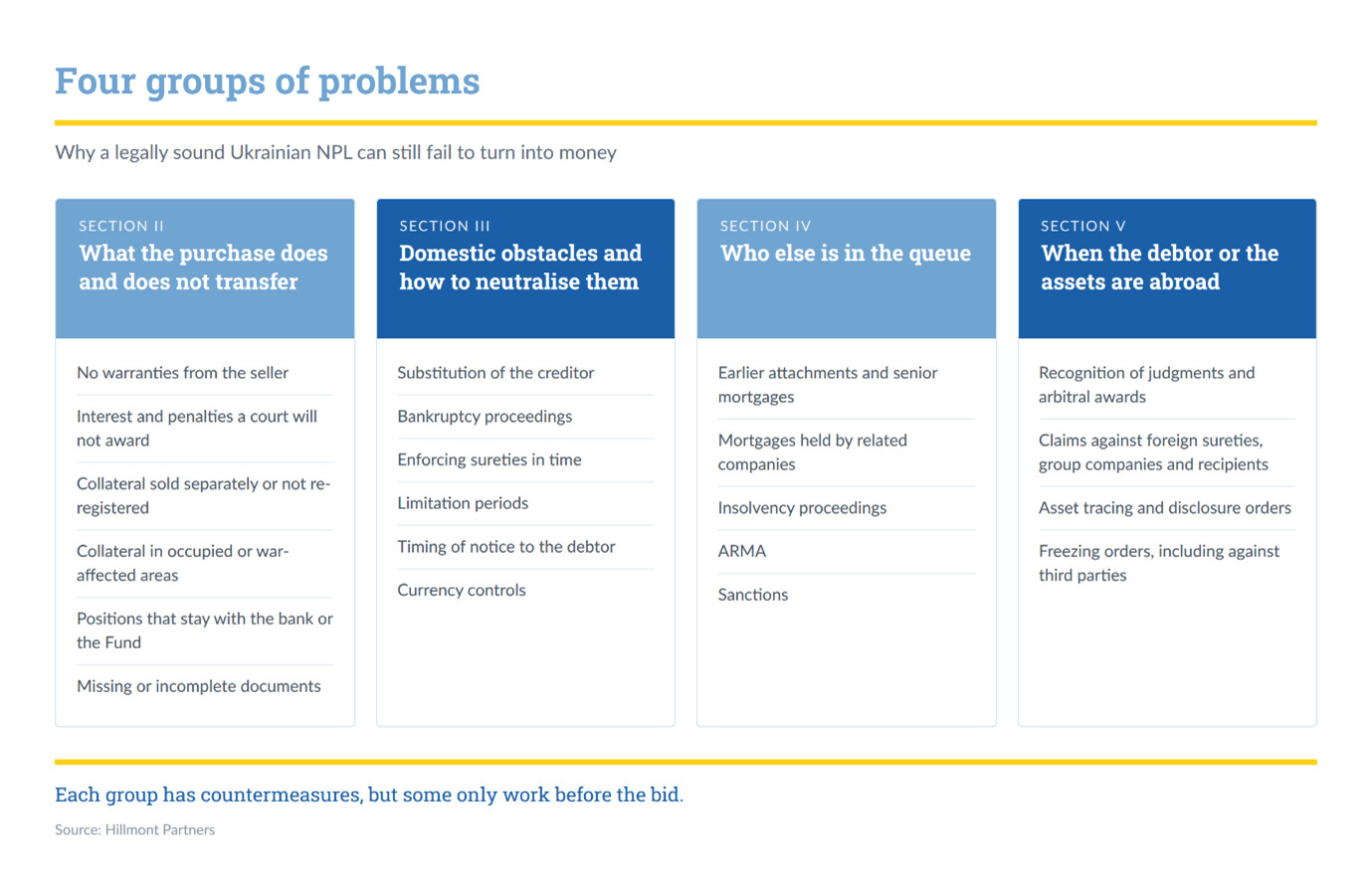
Each has countermeasures, but they divide sharply into those available after closing and those that only work before the bid.
II. What the Purchase Does and Does Not Transfer
The Deposit Guarantee Fund’s auction contract is a standard Ukrainian form on the seller’s terms: no representations, no warranty of collectability, no negotiation. Recourse against the seller is narrow, since the original creditor answers only if the claim itself is invalid, not if the debtor fails to pay,[5] and any claim leads back to a bank in liquidation, with a queue of creditors ahead of the buyer.
On a secondary acquisition, the risk that cannot be shifted to the Fund can be shifted to the seller through warranties, retentions or deferred instalments. Where foreign capital enters at one remove, through the winning bidder or a joint venture, the acquisition contract may be governed by foreign law, but that law governs only relations with the seller.
By contrast, everything aimed at the debtor is governed by the law of the claim, which determines assignability, the relationship with the debtor, the conditions for invoking the assignment against the debtor and whether the debtor’s obligations are discharged.[6]
The claim is fixed at the assignment date: the buyer takes it in the amount and on the terms then existing. The assignor must hand over the documents evidencing the rights transferred and the information material to their exercise.[7]
The outstanding balance shown in the loan file may exceed what the buyer can legally recover. After the maturity date or once the creditor demands early repayment, contractual interest stops accruing, and courts often refuse related penalties.[8] From that point the creditor can only claim 3% a year on the overdue amount, plus inflation losses on hryvnia debts, and this conclusion is confirmed by the Supreme Court.[9]
Where part of the security is sold separately, the bidder must verify what is actually in the lot. Although security follows the claim, mortgage enforcement requires registering the change of mortgagee, which demands an assignment in registrable form.[10]
Collateral located in occupied or war-affected areas may be inaccessible, damaged or destroyed, and is generally difficult to enforce against; state compensation usually covers only housing. Before bidding, the buyer should check the property’s location against the official list of occupied and combat territories and confirm its physical condition and accessibility. Movable collateral, such as equipment, vehicles or inventory, needs additional inspection: the pledge register shows the security but not where the assets are now, and they may have been relocated, sold, looted or requisitioned for military needs. In all these cases, the location and condition of the collateral are a major discount factor, and it should be valued very conservatively.
Some positions stay behind. Status as an injured party in criminal proceedings over asset-stripping normally stays with the bank, and the Fund’s claims against former owners stay with the Fund.
These risks can only be neutralised before payment. The file should be inventoried against what a court will require (credit agreements, security documents, proof of disbursement, debt calculations, notices and any acknowledgment of the debt), treating any missing link as a discount to the bid rather than a post-closing problem.
III. Domestic Obstacles and How to Neutralise Them
Substitution of the creditor is the first gate. A purchased claim does not move forward by itself. Wherever the original creditor has already acted, the buyer must be substituted in its place, whether in pending court or arbitration proceedings, in enforcement proceedings, or in a bankruptcy case. Each substitution takes time and opens its own window for challenge. Where no proceedings have yet been started, the buyer brings the claim in its own name and must prove the assignment from the outset.
Immediately after closing, the buyer should apply for substitution in every pending proceeding, attaching the complete chain of assignments.
Bankruptcy proceedings. A debtor that has defaulted on a bank loan is frequently already in bankruptcy proceedings, or enters them once enforcement begins.
Opening the bankruptcy proceedings triggers a moratorium on creditors’ claims and replaces individual enforcement with a collective process. The buyer must enter as creditor in the bankruptcy case, file its claim within the statutory deadline and, where the claim is secured by collateral, obtain recognition as a secured creditor. A buyer that holds a large share of the register can shape the process through the creditors’ committee; a buyer that arrives late may find that key decisions have already been taken.
Insolvency also provides useful tools. The insolvency officer, or a creditor, can challenge transactions the debtor entered into in the three years before the case was opened, such as sales at undervalue or transfers to related parties, and can seek subsidiary liability of owners and managers who brought the company to insolvency.[11] For a buyer whose debtor has been stripped of assets, these remedies are often the only way to reach value that has already left the company.
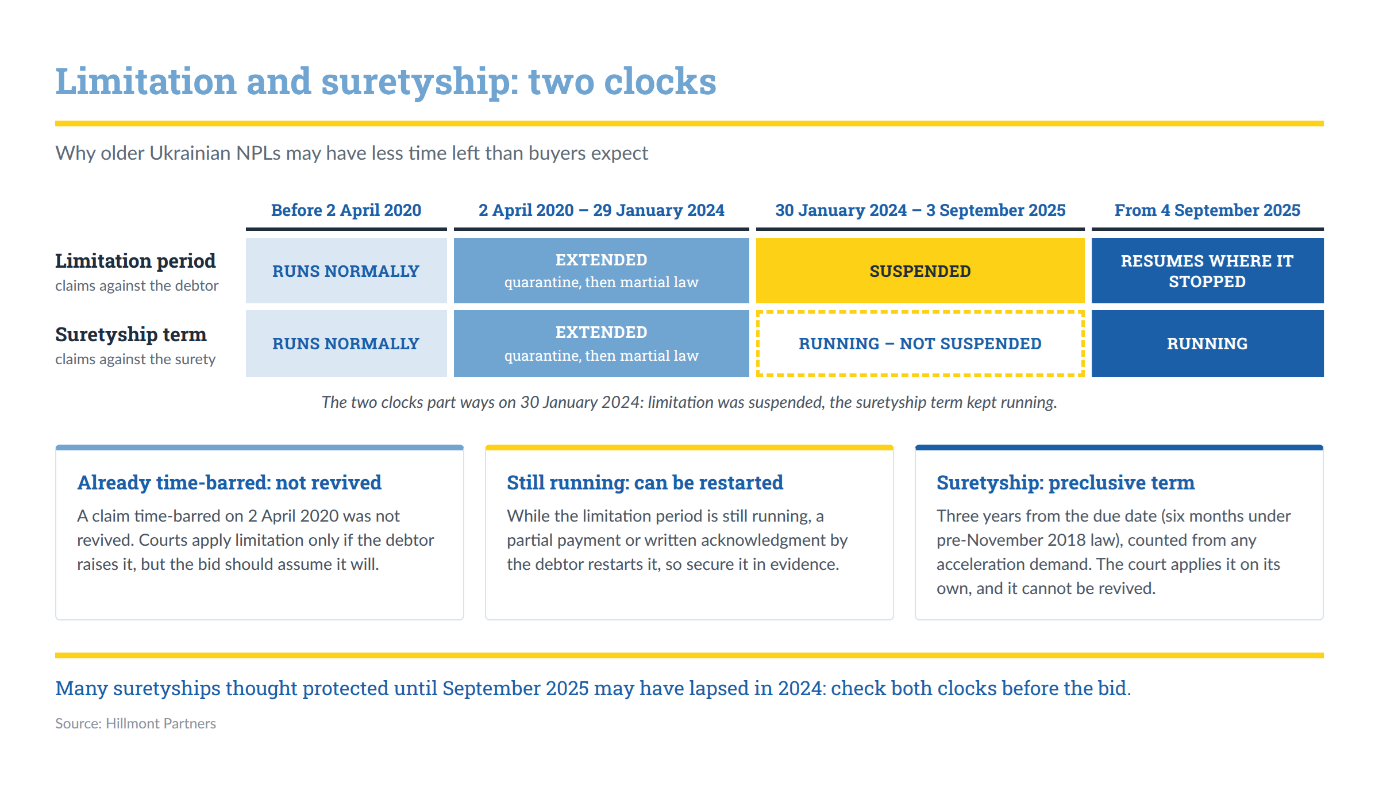
When the debtor itself is insolvent, the shortest route to money may lie outside the bankruptcy case: on corporate files, beneficial owners often provide personal sureties. They are usually solvent individuals with assets of their own. The suretyship should be enforced in parallel with the bankruptcy claim, and before the company is liquidated. Timing matters: unless the contract sets a term, the creditor must sue the surety within three years of the debt falling due.[12] The term is preclusive, as the Supreme Court explained: once it expires, the suretyship terminates and cannot be revived.[13] For older suretyships governed by the law in force before 4 November 2018, a six-month period applies. However, statutory extensions applied from 2 April 2020 to 30 June 2023 during the COVID-19 quarantine and from 17 March 2022 to 29 January 2024 under martial law.[14] The latter also extended suretyship periods expressly agreed by the parties.[15] The suspension that applied to limitation periods from 30 January 2024 did not cover the suretyship term, so many suretyships that appeared protected until September 2025 (as explained below) may in fact have lapsed in 2024. Notably, upon acceleration, the term for bringing a claim against the surety runs from the repayment deadline set in the demand, not from the contractual maturity date.[16]
Limitation has become an active risk. Limitation periods were extended from 2 April 2020 under the quarantine rules and then for the duration of martial law; from 30 January 2024 they were suspended. That suspension was lifted with effect from 4 September 2025 by Law of Ukraine No. 4434-IX.[17] Importantly, Ukrainian courts apply limitation periods only if the debtor raises this defence before judgment.[18] Theoretically, a time-barred claim may still succeed against a passive debtor, but the risk should be priced accordingly.
Periods did not restart: they resumed from the point at which they had stopped, so a claim already time-barred on 2 April 2020 was not revived, and on an accelerated loan the seller never sued on, the time left may now be short.
The time left should be verified before bidding, and any partial payment or written acknowledgment by the debtor should be secured in evidence, because it restarts a period still running.
Timing. Tracing and preservation rely on surprise, but the buyer pays first and the debtor learns of the change soon after. The buyer must therefore identify assets before bidding, prepare applications for attachment and production of documents for filing alongside the substitution application, and give notice only once the preservation step is ready.
Currency controls. After a foreign buyer successfully recovers an NPL in Ukraine, the next step would be to get the money out. Under martial-law currency controls, cross-border transfers are prohibited, including payments to non-resident creditors, unless an exemption from the National Bank of Ukraine (NBU) applies.[19] Generally, the debtor’s payments to a foreign buyer cannot be transferred abroad and the proceeds may have to stay onshore until the rules ease. The acquisition structure should therefore be settled before the bid.
IV. Who Else Is in the Queue
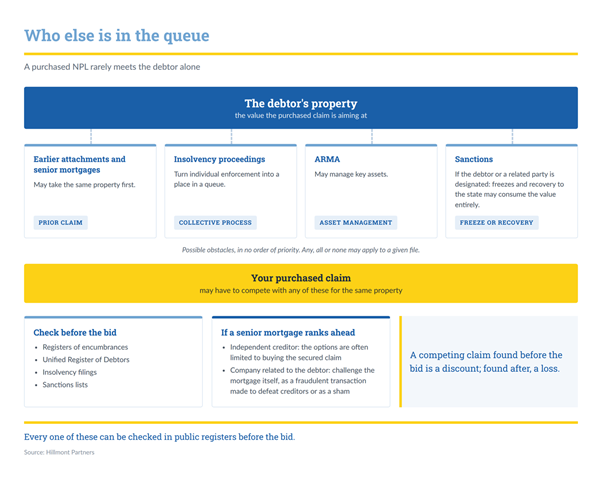
A purchased claim rarely meets the debtor alone.
Earlier attachments and senior mortgages take the same property first; insolvency proceedings convert individual enforcement into a place in a queue; ARMA (the Asset Recovery and Management Agency) may manage key assets; and where the debtor or a related party is designated, sanctions freezes and recovery to the state under the sanctions legislation may consume the value entirely.
The buyer can check all of this in advance across the registers of encumbrances, the Unified Register of Debtors, insolvency filings and the sanctions lists.
Where another creditor holds a prior-ranking mortgage, the options are often limited to buying the secured claim. In practice, the mortgage is sometimes held not by an independent creditor but by a company related to the debtor, registered to put the property out of other creditors’ reach. In such cases, the better course is usually to challenge the mortgage itself, either as a fraudulent transaction made to defeat creditors or as a sham.
V. When the Debtor or the Assets Are Abroad
There are several ways for an NPL to turn into a cross-border case. Relocation of assets, arbitration clause, a choice of foreign jurisdiction, or debtor ties to group companies abroad all may require at least partial enforcement abroad. In each scenario the route to the enforceable title may be different, but they share the same practical challenges: tracing and freezing the assets in time and, in the end, turning them into recovery. The tools for recovery vary widely in availability and effect from one jurisdiction to another, so a strategy must be built around the procedure of each legal system involved. Where the claim is strong but enforcement remains costly, third-party funding may ease that pressure: the funder covers legal costs in exchange for a share of the recovery.
Enforceable Ukrainian judgment. The Hague Judgments Convention 2019 has applied between Ukraine and the EU (except Denmark) since 1 September 2023 and between Ukraine and the United Kingdom since 1 July 2025, requiring recognition without review of the merits, provided the judgment meets one of the jurisdictional filters in Article 5 and is not refused on any of the grounds in Article 7. It covers only proceedings instituted after it entered into force between the two States, so many older disputes fall outside. Where the Hague Judgments Convention 2019 does not apply, enforcement of Ukrainian court judgments depends on bilateral treaties, the law of the enforcing state or reciprocity, with the uncertainty that carries.
Arbitral award. Corporate loans, particularly larger or more complex ones, often contain an arbitration clause. In many jurisdictions an assignment generally carries the arbitration agreement with it, so the buyer may be bound to arbitrate, but it also gains a more widely recognisable title. An arbitral award can be enforced under the New York Convention 1958 in more than 170 states, on narrow grounds for refusal. The buyer should verify early whether the clause has transferred, whether proceedings already exist, what the seat is and which procedural rules apply, as these determine the courts that can grant interim relief in support of the arbitration.
Other routes to reach the assets abroad. Sometimes the better route runs against the debtor’s related companies abroad, or against those who received the diverted assets or took part in dissipating them. In one of our cases, involving a claim acquired by our client from the Deposit Guarantee Fund, Ukrainian borrowers had paid large advances to related English companies for goods that were never delivered. The English companies were then dissolved, and the money moved on through the group into its businesses in other countries. The English companies were restored to the register, giving access to their records and a basis for suing them in England, with the beneficial owner and other group companies joined as necessary or proper parties. The claims were for transactions defrauding creditors and unlawful means conspiracy. The High Court granted a worldwide freezing order against the defendants in England and abroad. Ultimately, the case resulted in a multi-million-dollar settlement and a high return on investment for our client.
Asset tracing. A title is only as valuable as the assets the creditor can reach. Asset tracing typically begins prior to formal litigation through comprehensive pre-action mapping. Creditors cross-check public registers to identify holding entities and suspect transfers. For example, in the UK, the Register of Overseas Entities links offshore companies holding UK property to their beneficial owners. Where offshore layering obscures ultimate control, creditors increasingly deploy tech-driven solutions like email metadata analytics. By revealing hidden banking links and foreign jurisdictions without prior court intervention, these non-intrusive tools establish the factual threshold necessary to seek targeted judicial disclosure orders.[20]
Once that threshold is met, English courts can order disclosure from third parties even where no claim is brought against them. Claimants deploy Norwich Pharmacal orders against formation agents and intermediaries to unmask beneficial owners and transfer agreements, paired with Bankers Trust orders against financial institutions to trace misappropriated funds across accounts.[21]
In the United States, 28 U.S.C. § 1782 allows a party to foreign proceedings to obtain evidence from persons and companies found in the US, including banks and payment intermediaries. This makes it particularly effective for tracing dollar payments, which almost all pass through US correspondent accounts. The statutory requirements are that the person from whom evidence is sought resides or is found in the relevant US judicial district, the evidence is intended for use before a foreign or international tribunal, and the request comes from that tribunal or an interested person.[22] The evidence need not be discoverable under the foreign forum’s own rules, and applications are often made without notice. However, § 1782 does not apply to private commercial arbitration.[23] Granting relief hinges on four discretionary factors: the target’s non-participant status abroad, the foreign tribunal’s receptivity, the absence of circumvention of foreign evidentiary rules, and the request’s proportionality.[24]
Freezing injunctions (or freezing orders) are a cornerstone of interim asset protection in common law jurisdictions: they prevent a defendant from dissipating assets before a final judgment or award is obtained. Orders may cover assets in England only or worldwide, and usually require the defendant to disclose its assets.[25]
English courts grant worldwide freezing orders (WFOs) as exceptional measures, including without notice, where the applicant shows a good arguable case, a real risk that assets will be dissipated so that a judgment or award goes unsatisfied, and that the order is just and convenient. A WFO also requires the defendant to be subject to the court’s jurisdiction.
WFOs were granted against Ukrainian debtors, a good example is the case of PJSC Commercial Bank PrivatBank v Kolomoisky & Others, where the English High Court granted a WFO in 2017 over the assets of Mr Kolomoisky, Mr Bogolyubov and six companies they controlled.
English courts can also extend a freezing order to third parties who hold assets for, or on behalf of, the defendant (a Chabra order).[26] This is particularly relevant where the debtor’s assets have been moved into related companies within the group. Such relief may be granted where the third party is demonstrated to act as a nominee or conduit, or otherwise to hold or control assets beneficially owned by the defendant. The evidential bar is high, but once it is cleared, those assets can be frozen as if the defendant held them directly.
VI. A Practical Sequence
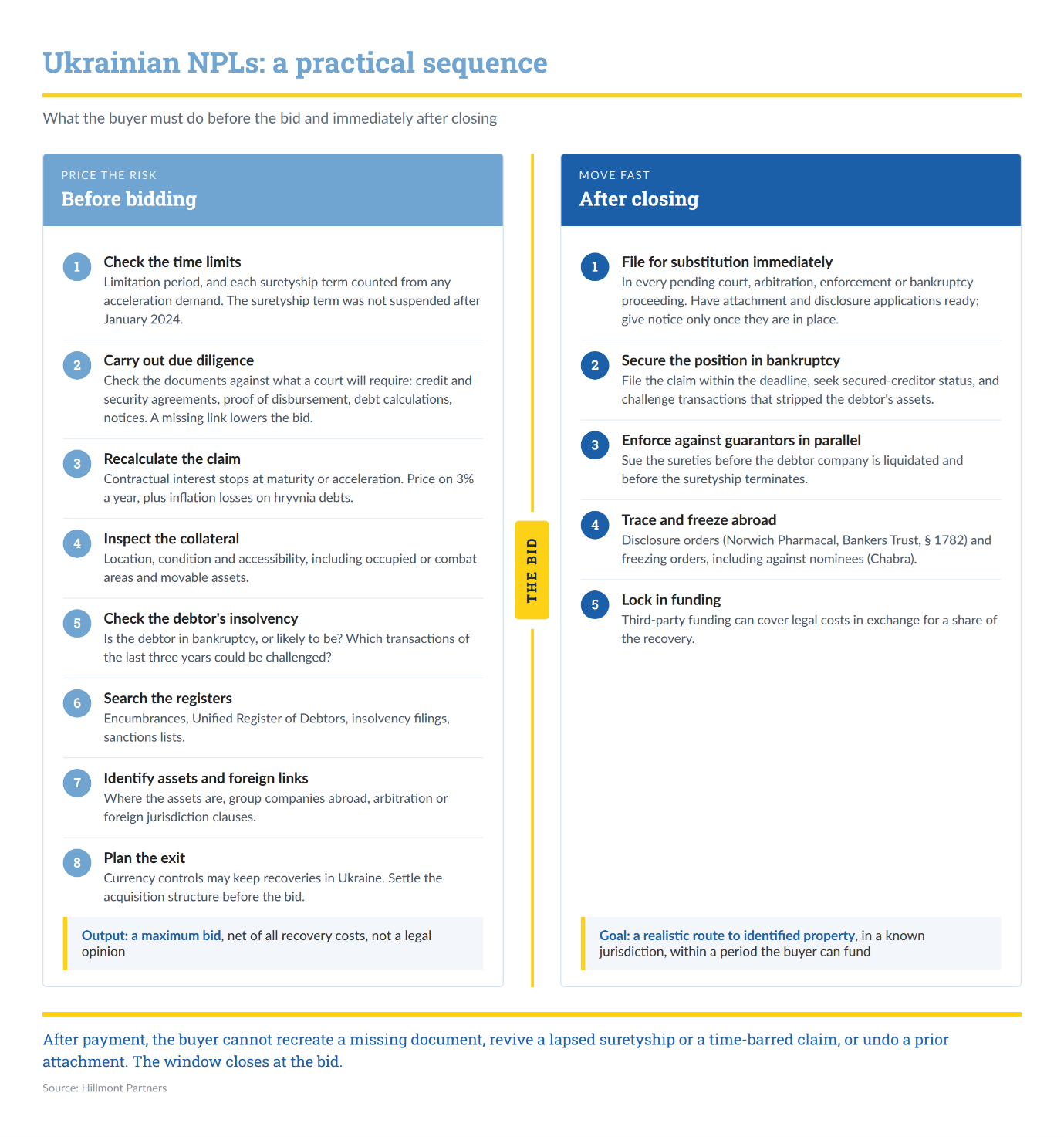
Due diligence before the bid should do more than produce a legal opinion: it should produce a maximum price. Most of the risks discussed in this article cannot be cured after closing. Once the claim is bought, speed matters most, because the buyer needs to secure its position before the debtor reacts. The sequence below summarises both stages.
VII. Conclusion
Recovery on Ukrainian NPLs is resource-intensive, but the decisive constraints are legal and can be identified in advance: what the assignment carries, whether the debtor is in bankruptcy, whether the guarantees and limitation periods are still alive, who else claims the same property, and where the assets sit.
Most of these questions must be answered before the bid. After payment, the buyer cannot recreate a missing document, revive a lapsed suretyship or a time-barred claim, or undo a prior attachment. What remains after closing is speed: substitution, preservation, and parallel action against the debtor, its guarantors and, where necessary, within insolvency proceedings.
Where the assets are abroad, recovery depends not only on the original claim and security instruments, but also on the tools available where the assets are now: recognition of a judgment or award, disclosure orders that trace funds through banks and intermediaries, and freezing orders that reach nominees and related companies. These tools work best when they are planned before the debtor learns that the claim has changed hands.
A claim becomes an asset only when there is a realistic route to identified assets, in a known jurisdiction, within a period the buyer can fund.
[1]National Bank of Ukraine, NPL share in the banking sector as at 1 July 2026, https://bank.gov.ua/ua/news/all/chastka-npl-u-bankivskomu-sektori-onovila-17-richniy-minimum.
[2]Deposit Guarantee Fund of Ukraine sales through Prozorro.Sale: https://minfin.com.ua/ua/2026/07/02/176960106/ and https://epravda.com.ua/biznes/fgvfo-za-kvartal-prodav-prava-vimogi-za-kreditami-na-963-2-milyona-griven-820348/.
[3]Deposit Guarantee Fund of Ukraine data for June 2026, reported at https://minfin.com.ua/ua/2026/07/02/176960106/.
[4]Regulation on the Organisation of the Sale of Assets (Property) of Banks under Liquidation, approved by Decision of the Executive Directorate of the Deposit Guarantee Fund of Ukraine No. 388 of 24 March 2016, section VII, paras 8–13.
[5]Civil Code of Ukraine, art 519.
[6]Regulation (EC) No. 593/2008 (Rome I), art 14(2), https://eur-lex.europa.eu/eli/reg/2008/593/oj/eng; Law of Ukraine “On Private International Law” No. 2709-IV of 23 June 2005, art 47(1)(8).
[7]Civil Code of Ukraine, art 517.
[8]Grand Chamber of the Supreme Court of Ukraine, Judgment of 28 March 2018, Case No. 444/9519/12, https://reyestr.court.gov.ua/Review/74838904; Supreme Court, Judgment of 6 February 2019, Case No. 175/4753/15-ц, https://reyestr.court.gov.ua/Review/79958126.
[9]Civil Code of Ukraine, art 625.
[10]Law of Ukraine “On Mortgage”, art 24(3).
[11]Code of Ukraine on Bankruptcy Procedures, arts 42 and 61.
[12]Civil Code of Ukraine, art 559.
[13]Grand Chamber of the Supreme Court of Ukraine, Judgment of 4 July 2023, Case No. 2-1268/11 (Proceedings No. 14-2цс23), https://reyestr.court.gov.ua/Review/112406151.
[14]Civil Code of Ukraine, Final and Transitional Provisions in redaction from 05.08.2026, para. 12; in redaction from 17.03.2022, para. 19; and in redaction from 30.01.2024, para. 19.
[15]Supreme Court, Judgment of 17 September 2024, Case No. 910/11759/22, https://reyestr.court.gov.ua/Review/121782540.
[16]Grand Chamber of the Supreme Court of Ukraine, Judgment of 10 April 2019, Case No. 604/156/14-ц (Proceedings No. 14-644цс18), https://reyestr.court.gov.ua/Review/81573930.
[17]Law of Ukraine No. 540-IX of 30 March 2020, section 5; Law of Ukraine No. 3450-IX of 8 November 2023, section 1(2); Law of Ukraine No. 4434-IX of 14 May 2025.
[18]Civil Code of Ukraine, art 267.
[19]National Bank of Ukraine, Resolution No. 18 of 24 February 2022, para. 14.
[20]TerraLex, Guide to Tracing Assets Around the World (2018), https://mcmillan.ca/wp-content/uploads/2021/07/TerraLex-guide-to-tracing-assets-around-the-world-2018.pdf.
[21]Norwich Pharmacal Co v Customs and Excise Commissioners [1974] AC 133 (HL); Bankers Trust Co v Shapira [1980] 1 WLR 1274 (CA).
[22]28 U.S.C. § 1782(a).
[23]ZF Automotive US, Inc. v Luxshare, Ltd., 596 U.S. 619 (2022).
[24]Intel Corp. v Advanced Micro Devices, Inc., 542 U.S. 241 (2004): https://supreme.justia.com/cases/federal/us/542/241/.
[25]Senior Courts Act 1981, s 37(1); Mareva Compania Naviera SA v International Bulkcarriers SA [1975] 2 Lloyd’s Rep 509 (CA); Civil Jurisdiction and Judgments Act 1982, s 25.
[26]TSB Private Bank International SA v Chabra [1992] 1 WLR 231.

Address: 36-D Yevhena Konovaltsia Street, 5th Floor,
Kyiv, 01133, Ukraine;
Tel.: +380 44 277 2447
E-mail: office@hillmont.com
London Office: 105 Victoria Street, 6th Floor, Westminster,
London, SW1E 6QT, United Kingdom;
Tel.: +44 2034 572881;
Web-site: www.hillmont.com
Hillmont Partners is a leading law firm which was founded by British and Ukrainian partners with a view to providing high-quality legal services to investors and businesses operating or looking to operate in Ukraine. With three offices in Ukraine (Kyiv, Lviv, Odesa) and office in London, Hillmont is connecting the potential of Ukraine with global investors and businesses.
The firm offers the expertise and insight needed to help clients operate in the complex legal and regulatory landscape. We guide our clients through all stages of the regulatory and permitting process, advise on investment projects, assist with government relations and public affairs, regulatory and risk management, offer corporate governance, commercial, labour and tax law advice, and handle any litigation or arbitration involving our clients.
The firm’s lawyers provide commercially-focused advice across a variety of industry sectors in the fast-changing business environment in Ukraine. Multinational companies, investors, financial institutions and project developers face numerous challenges in operating and investing in Ukraine. Our team is committed to forward thinking to help clients stay ahead of the curve, either identifying opportunities or managing uncertainty.
Hillmont Partners is especially strong in complex litigation, investment advisory and government relations and public affairs. Our experts work to defend the interests of our clients when they face the most challenging of threats to their businesses and we help ensure that those investing in Ukraine are appraised of all the risks and are comprehensively protected throughout the life of their projects.
Our team is made up of experienced commercial lawyers and criminal defence attorneys, finance professionals who have a wealth of knowledge about distressed investing and strategic communications professionals advising on interaction between businesses and state authorities.
We help our clients to navigate Ukraine’s dynamic transformation. Our experienced and professional team offers a full range of services in the field of government relations and public affairs, regulatory and risk management, including development and implementation of comprehensive GR&PA strategies; regulatory and policy analysis and monitoring; crisis communications and issue management; legislative drafting and advocacy.
Our firm’s industry-specific expertise covers counselling international and local businesses across many sectors, including mining, energy, metallurgy and machinery, banking and finance, IT and start-ups, agriculture, FMCG and retail, commercial real estate, etc.